PINILIT AKONG PUMIRMA SA KASAL SA ISANG LALAKING PINULOT DAW NG TIYUHIN KO SA TERMINAL PARA MAPATUNAYANG “HINDI AKO KARAPAT-DAPAT” MAMAHALA SA KUMPANYA—PERO BAGO AKO MAKAPAGSABI NG OO, TUMINGIN SA AKIN ANG LALAKING NAKASUOT NG KUPAS NA BARONG AT BUMULONG, “HUWAG KANG PIPIRMA. HINDI KASAL ANG GUSTO NG TIYUHIN MO—ANG PIRMA MO ANG KAILANGAN NIYA.”
PINILIT AKONG PUMIRMA SA KASAL SA ISANG LALAKING PINULOT DAW NG TIYUHIN KO SA TERMINAL PARA MAPATUNAYANG “HINDI AKO KARAPAT-DAPAT” MAMAHALA SA KUMPANYA—PERO BAGO AKO MAKAPAGSABI NG OO, TUMINGIN SA AKIN ANG LALAKING NAKASUOT NG KUPAS NA BARONG AT BUMULONG, “HUWAG KANG PIPIRMA. HINDI KASAL ANG GUSTO NG TIYUHIN MO—ANG PIRMA MO ANG KAILANGAN NIYA.”
Ako si Isabel Monteverde.
Dalawampu’t pito ako nang mamatay ang tatay kong si Ramon.
Hindi siya namatay sa lason.
Walang lihim na mamamatay-tao.
Walang dramatikong huling habilin.
Isang ordinaryong Martes ng umaga, habang naghahanda para sa board meeting, inatake siya sa puso.
By lunchtime, wala na siya.
Ang huling text niya sa akin ay:
Anak, pakidala yung blue folder. Naiwan ko sa study.
Hindi ko naibigay ang folder.
For months, hindi ko iyon mabuksan.
Ako ang panganay.
May nakababata akong kapatid na lalaki, si Paolo, nineteen years old.
May congenital heart condition siya at dalawang beses nang naoperahan.
Hindi siya inutil.
Hindi rin siya mahina.
Pero dahil sa kalagayan niya, sinadya ni Papa na ilayo muna siya sa mabibigat na responsibilidad sa negosyo habang nag-aaral.
Kaya ako ang matagal niyang sinasanay.
Monteverde Properties.
Hindi pinakamalaking real estate company sa bansa.
Pero sapat ang laki para magkaroon ng daan-daang empleyado, ilang commercial buildings, residential projects at malaking utang sa mga bangko.
Bago namatay si Papa, ako ang chief operating officer.
Ang tiyuhin kong si Eduardo—nakababatang kapatid ni Papa—ang executive vice president.
At sa unang buwan pagkatapos ng libing, siya ang pinakamabait na taong nakilala ko.
“Magpahinga ka muna.”
“Ako bahala sa board.”
“Ako muna kakausap sa banks.”
“Alagaan mo si Paolo.”
Akala ko tinutulungan niya ako.
Hindi ko alam na habang nagpapahinga ako, unti-unti niyang inilalayo sa akin ang lahat.
Access sa ilang company accounts.
Meetings.
Mga dokumentong dati ay diretso sa akin.
Mga department heads na biglang sa kanya na nag-uulat.
Nang magtanong ako, pareho ang sagot.
“Temporary lang.”
Then one evening, sinabi niyang may problema ang testamento ni Papa.
Hindi raw diretsong mapupunta sa akin ang kontrol ng kumpanya.
“May kondisyon.”
I stared at him.
“Anong kondisyon?”
He handed me several pages.
Legal language.
Trust provisions.
Voting arrangements.
Family holding company.
At isang clause na ipinakita niya sa akin.
Ayon sa paliwanag niya, kapag gumawa raw ako ng “reckless personal decision” na makakasira sa reputasyon at katatagan ng kumpanya, maaaring pansamantalang ilipat sa family trustee ang ilang voting rights habang sinusuri ang kakayahan kong mamahala.
“Anong kinalaman niyan sa akin?”
He smiled.
“Lahat.”
Then he told me he’d arranged my marriage.
I laughed.
He didn’t.
“Excuse me?”
“Next Friday.”
“Are you insane?”
“Careful.”
“Hindi ako magpapakasal.”
“Then we have another problem.”
He placed a medical billing statement on the table.
Paolo.
His upcoming procedure.
May bahagi na covered ng insurance.
May malaking bahagi na hindi.
Then Eduardo said:
“The company medical assistance we’ve been providing can stop.”
My blood ran cold.
“You wouldn’t.”
“I’m simply saying maraming bagay ang nakadepende sa cooperation.”
“You’re threatening Paolo.”
“No.”
He smiled.
“I’m reminding you how expensive love can be.”
I wanted to slap him.
Instead, I stood.
“Who?”
“Sino?”
“Yung ipapakasal mo sa akin.”
He laughed.
“Ah.”
His name was Gabriel.
According to Eduardo, isa siyang lalaking natutulog malapit sa provincial bus terminal.
Walang regular na trabaho.
Walang permanenteng tirahan.
Minsan naghuhugas ng jeep.
Minsan nagbubuhat sa palengke.
Eduardo had already invited reporters.
Not the whole country.
But enough business and society media to turn it into humiliation.
His plan became obvious.
If I refused, he would portray me as unstable and uncooperative during a corporate crisis.
If I agreed, he intended to use the bizarre marriage as evidence that I was reckless enough to trigger governance protections.
Either way, he expected to strengthen his grip on the company.
But there was a problem with his plan.
The clause he showed me didn’t actually say marriage to a poor person automatically disqualified me.
I noticed that.
“Where’s the rest of the trust document?”
He looked at me.
“You don’t need it.”
“I do.”
“Your father’s lawyers already explained it.”
“To you.”
He stood.
“Isabel.”
“No.”
Then he leaned close.
“Think about your brother.”
That’s how he got me.
Not because I cared about public humiliation.
I could survive gossip.
But Paolo was scheduled for another cardiac procedure.
And Eduardo had spent weeks making me believe access to funds and approvals depended on him.
So I said yes.
Not because I wanted to.
Because I thought I had no choice.
The ceremony was held in a small old church owned by a foundation our family supported.
That detail made everything worse.
Papa had attended Mass there.
Mama’s funeral had been held there years earlier.
Eduardo turned it into a stage.
There were reporters outside.
Several executives inside.
Some relatives.
A few investors.
And me.
White dress.
No veil.
No smile.
Then I saw the groom.
Gabriel.
He wasn’t cartoonishly filthy.
The church wouldn’t have allowed someone covered in mud to walk around the sanctuary anyway.
But his clothes were obviously borrowed.
Old barong.
Worn trousers.
Cheap shoes.
His hair was long.
His face thin.
There was a healing cut near his eyebrow.
He looked tired.
But not ashamed.
That surprised me.
As I approached the altar, he looked directly at me.
Not at my dress.
Not at the cameras.
At me.
And something about his expression made me slow down.
We stood beside each other.
The priest looked uncomfortable.
He should have.
A marriage requires consent.
And mine was anything but free.
Before the ceremony could proceed, Gabriel leaned slightly toward me.
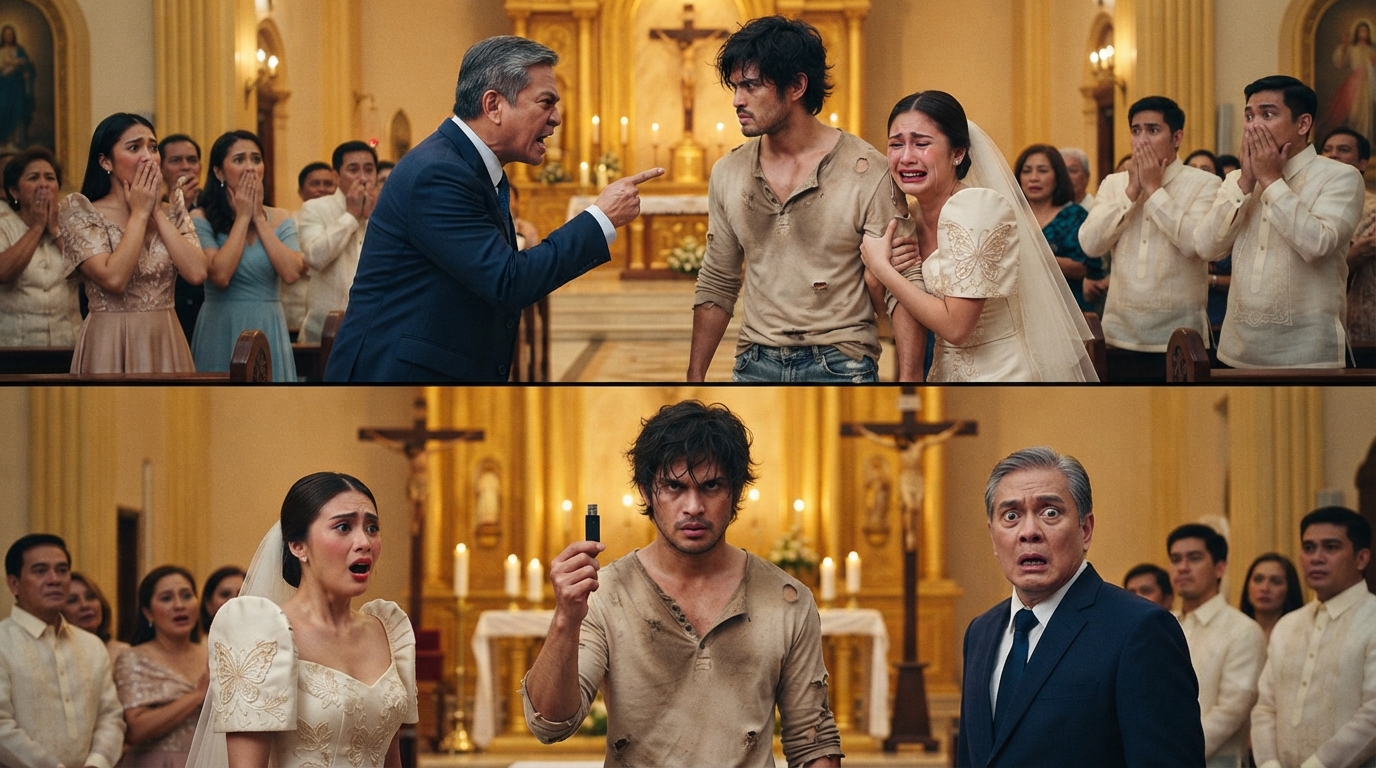
“Huwag kang pipirma.”
I froze.
“What?”
His voice remained low.
“May dokumentong ipapapirma pagkatapos.”
I stared at him.
“Paano mo alam?”
“Because I’ve seen it.”
My heart started pounding.
“What document?”
“Hindi marriage certificate lang.”
I looked toward Eduardo.
He was smiling.
Gabriel continued:
“May acknowledgment at waiver na isasabay sa papers. Kapag pinirmahan mo, may language tungkol sa voluntary relinquishment ng ilang management rights habang nire-review ang trust.”
My mouth went dry.
“How do you know that?”
He looked at me.
“Because your uncle made a mistake.”
“What mistake?”
“He assumed a homeless man couldn’t read.”
Before I could answer, the priest cleared his throat.
“Are we ready?”
“No.”
My voice echoed through the church.
Everyone turned.
Eduardo stood.
“Isabel.”
I faced him.
“I want to see every document I’m expected to sign.”
His smile disappeared.
“This isn’t the time.”
“Then there is no wedding.”
The reporters immediately started whispering.
Eduardo approached.
“Don’t embarrass the family.”
“You invited cameras.”
His jaw tightened.
Then Gabriel stepped forward.
“I think she should see the papers.”
Eduardo stared at him.
“Hindi kita binayaran para magkaroon ng opinyon.”
The entire church went quiet.
Gabriel nodded.
“That’s true.”
Then he reached into the inside pocket of his old barong.
He removed a folded envelope.
“But you did pay me.”
He opened it.
Cash.
A handwritten instruction sheet.
And photocopies.
Eduardo’s face changed.
“What are you doing?”
Gabriel looked toward the reporters.
Then at the priest.
Then at me.
“Mr. Monteverde’s people approached me nine days ago. They offered me fifty thousand pesos to participate.”
A murmur spread through the church.
Eduardo shouted:
“Sinungaling!”
Gabriel continued.
“I was instructed to say I had no job, no family and no permanent address. I was told not to speak to Ms. Monteverde privately. After the ceremony, I was supposed to disappear.”
I stared at him.
“Why did you agree?”
His expression became complicated.
“Because I needed the money.”
That answer surprised everyone.
No secret billionaire reveal.
No wig removed.
No expensive suit underneath.
Just a man admitting he needed fifty thousand pesos.
“My mother is in a dialysis program,” he said. “May utang kami. Nawalan ako ng trabaho eight months ago.”
Eduardo laughed.
“See? Pulubi nga!”
Gabriel looked at him.
“Wala akong trabaho.”
Then he straightened.
“Hindi ibig sabihin noon na tanga ako.”
He pulled out another set of papers.
“I studied law for three years.”
Silence.
“I didn’t finish.”
He looked at me.
“My father died. I stopped school. I worked in warehouses, delivery services, construction sites. Then my mother got sick.”
Eduardo moved toward him.
“Give me those.”
Gabriel stepped back.
“No.”
“What exactly did you read?” I asked.
“Enough to know you shouldn’t sign anything without your own lawyer.”
That sentence changed the entire day.
Not because Gabriel had evidence of murder.
He didn’t.
Not because he could arrest my uncle.
He couldn’t.
Because for the first time in weeks, someone said the obvious thing everyone around me had avoided.
Get your own lawyer.
I turned toward Eduardo.
“Where is Attorney Mendoza?”
“Our family counsel?”
“Yes.”
“He’s unavailable.”
“Then I’ll wait.”
“You can’t.”
“Why?”
“The board meets Monday.”
There.
Gabriel looked at me.
I understood.
This wasn’t really about the wedding.
Monday.
Something was happening Monday.
I removed the bouquet from my hands.
Placed it on the pew.
“Wedding’s over.”
Eduardo grabbed my arm.
“You walk out now and Paolo loses everything.”
I pulled away.
Then another voice came from behind us.
“No, he doesn’t.”
My godmother, Teresa Alcantara, stood from the third row.
She had been Papa’s corporate secretary years earlier before retiring.
I hadn’t even known Eduardo invited her.
Apparently he had invited anyone whose presence made the spectacle look legitimate.
Bad decision.
She walked toward us.
“What did you say about Paolo’s medical support?”
Eduardo’s face tightened.
“Private family matter.”
Teresa looked at me.
“Isabel, did he tell you he personally controls the medical trust your father established?”
“Yes.”
“He doesn’t.”
I couldn’t breathe.
“What?”
“The medical trust is independently administered.”
Eduardo interrupted.
“She doesn’t know the current arrangement.”
Teresa ignored him.
“Your father funded it separately after Paolo’s second surgery.”
I stared at my uncle.
“You lied.”
He said nothing.
Teresa continued:
“And the family holding trust does not automatically strip you of voting rights because you marry someone poor.”
The church erupted in whispers.
“Then what does the clause mean?”
“Exactly what it says. A formal review can be initiated under specified circumstances. It requires trustees. Evidence. Procedure. Your uncle cannot simply declare you incompetent because he dislikes your spouse.”
I turned toward Eduardo.
Everything began making sense.
He needed more than the marriage.
He needed my signature.
The wedding was theater.
The paperwork was the trap.
I felt physically sick.
Gabriel quietly handed me the copies.
“There’s more.”
I looked.
Attached to one document was a written declaration.
It stated that due to emotional distress following my father’s death, I was voluntarily stepping back from active management.
Another section acknowledged Eduardo as interim representative for certain corporate matters.
“I never agreed to this.”
“I know,” Gabriel said.
“How did you get it?”
“They gave me a packet to memorize where I needed to sign.”
“You weren’t supposed to read hers.”
“No.”
He almost smiled.
“They underestimated how boring unemployment can get.”
Even I laughed.
Just once.
Eduardo didn’t.
He walked out of the church.
The wedding never happened.
And no police were waiting outside.
Because being a terrible uncle isn’t enough for handcuffs.
We had to investigate.
That took months.
The Monday board meeting went ahead.
But this time, I attended with independent counsel.
Teresa helped me locate Papa’s original estate lawyers.
The complete trust documents were reviewed.
Then came the financial records.
Eduardo had been moving aggressively to consolidate control.
Some actions were legal.
Some were questionable.
Several transactions involved companies connected to people close to him and had not been disclosed as clearly as they should have been.
There were also company funds used for expenses that auditors challenged.
But again—
we didn’t scream “theft” before proving it.
An independent investigation followed.
The board formed a special committee.
External accountants came in.
Lenders asked questions.
It was ugly.
Slow.
Expensive.
Eduardo wasn’t removed because I was angry.
His authority weakened because directors and lenders no longer trusted the information coming from him.
Eventually, he resigned from executive management.
Some financial matters became civil disputes.
Other findings were referred where appropriate.
Not every allegation survived scrutiny.
Enough did.
The empire he thought he had already captured didn’t explode in one afternoon.
It slipped away from his hands one signature, one meeting and one verified record at a time.
As for Gabriel—
I found him three days after the cancelled wedding.
Not in a penthouse.
At a dialysis center.
He was sitting beside an older woman.
His mother.
When he saw me, he stood.
“Ms. Monteverde.”
“Isabel.”
His mother looked between us.
“Gabriel, siya ba yung ikakasal sana sa’yo?”
He closed his eyes.
“Ma.”
I almost laughed.
“Yes po.”
His mother slapped his arm.
“Hindi mo sinabi maganda!”
“Ma!”
That was the first normal moment I’d had in weeks.
I sat with them.
Then I handed Gabriel an envelope.
He didn’t take it.
“What is that?”
“The rest of the fifty thousand my uncle promised you.”
“No.”
“You helped me.”
“I didn’t do it for a reward.”
“You did it because he hired you.”
He smiled slightly.
“Technically.”
“Take it.”
“No.”
So I changed strategy.
“Fine.”
I put it back.
“Then I have another offer.”
His face became suspicious.
“What?”
“Our legal department has an opening for a records and compliance assistant.”
He laughed.
“You’re offering a former almost-husband a job?”
“I’m offering someone who actually reads documents a job.”
“I didn’t finish law school.”
“The position doesn’t require you to be a lawyer.”
He became quiet.
Then asked:
“Is this charity?”
“No.”
“Pity?”
“No.”
“Guilt?”
“Gabriel.”
“Yes?”
“You’re making the interview difficult.”
He laughed.
He applied.
Properly.
HR interviewed him.
I stayed out of the final hiring decision.
He got the job.
Six months later, he returned to evening classes.
Two years later, he finished his degree.
Later, he completed the requirements necessary to pursue the profession he had abandoned when his family fell apart.
We became friends during those years.
Only friends.
I was recovering from coercion and grief.
He was rebuilding his career while caring for his mother.
Neither of us needed a fairy-tale romance.
We needed normal lives.
Sometimes we’d eat lugaw after his evening classes.
Sometimes he’d help Paolo argue with me about football.
Sometimes I’d visit his mother during dialysis.
And sometimes we’d joke about our failed wedding.
“You didn’t even say yes,” he’d complain.
“You told me not to.”
“Still rude.”
“You smelled like mothballs.”
“Borrowed barong.”
“Explains everything.”
Three years after that day, Gabriel asked me to dinner.
“Just us?”
“Yes.”
“Why?”
He stared at me.
“Isabel, you’re excellent at business but exhausting in other areas.”
“What does that mean?”
“It means I’m asking you on a date.”
Oh.
That.
Our first date cost less than the flowers Eduardo had ordered for our fake wedding.
I liked it better.
We dated for almost two years.
Then one Sunday afternoon, Gabriel brought me back to the same church.
Empty this time.
No reporters.
No executives.
No uncle.
He didn’t kneel immediately.
Instead, he asked:
“Do you remember what I told you here?”
“Huwag akong pipirma.”
“Correct.”
He handed me a folded paper.
I opened it.
Blank.
I laughed.
“What is this?”
“Whatever happens next, ikaw ang magsusulat.”
Then he knelt.
“Isabel, will you marry me?”
I cried.
But before answering, I said:
“May kondisyon.”
His face changed.
“What?”
“I read everything first.”
He laughed so loudly the caretaker looked inside.
“Deal.”
I said yes.
Our real wedding happened four months later.
Small.
Paolo was best man.
Gabriel’s mother sat in the front row.
Teresa cried before the ceremony even started.
And this time, when documents were placed in front of me afterward—
I read every line.
Gabriel waited.
No rushing.
No jokes.
When I finally signed, he asked:
“Sure?”
I looked at him.
“Yes.”
That word felt completely different when nobody had forced it out of me.
Years later, Paolo once asked whether I believed Gabriel had been “destined” to appear at that first wedding.
I told him no.
I don’t think destiny sent me a disguised billionaire.
Gabriel wasn’t secretly rich.
He wasn’t powerful.
He didn’t rescue me with an army.
He was an unemployed man caring for a sick mother who accepted a questionable job because he needed money.
Then he discovered someone was being coerced.
And when the moment came, he chose not to cooperate with it.
That’s what mattered.
Eduardo’s greatest mistake wasn’t hiring the wrong poor man.
It was believing poverty meant a person had no dignity.
He thought money could buy Gabriel’s silence.
He thought family could buy my obedience.
He thought medical bills could buy my fear.
He thought a public wedding could turn humiliation into proof that I was weak.
He misunderstood all of us.
I still run Monteverde Properties today.
Not because I was born with the right surname.
Because after Papa died, I finally learned to lead without hiding behind it.
Gabriel built his own career.
Paolo finished college.
And the medical trust Papa created for him eventually became the inspiration for a small foundation supporting families dealing with long-term pediatric cardiac care.
Sometimes I keep one thing from that first wedding in my office.
Not the dress.
Not the photographs.
The unsigned document Eduardo wanted me to sign.
Across the top, in my own handwriting, I eventually wrote:
Hindi lahat ng papel na inilalagay sa harap mo ay obligasyon mong pirmahan.
Visitors sometimes ask what it means.
I usually smile.
Because that lesson wasn’t only about contracts.
For years, I thought being a good daughter meant accepting the future chosen by family.
That protecting Paolo meant surrendering myself.
That having money meant I should never admit I was afraid.
And that being poor meant Gabriel needed saving more than I did.
I was wrong about all of it.
The man my uncle hired to humiliate me didn’t turn out to be a billionaire.
He turned out to be something far rarer that day.
A person who had every reason to take the money and remain silent—
but spoke anyway.
And the first thing he ever gave me wasn’t an empire, protection or a diamond ring.
It was one sentence.
“Huwag kang pipirma.”
Years later, when I finally did sign our marriage certificate, I looked at him before putting pen to paper.
He smiled.
“Sigurado ka?”